


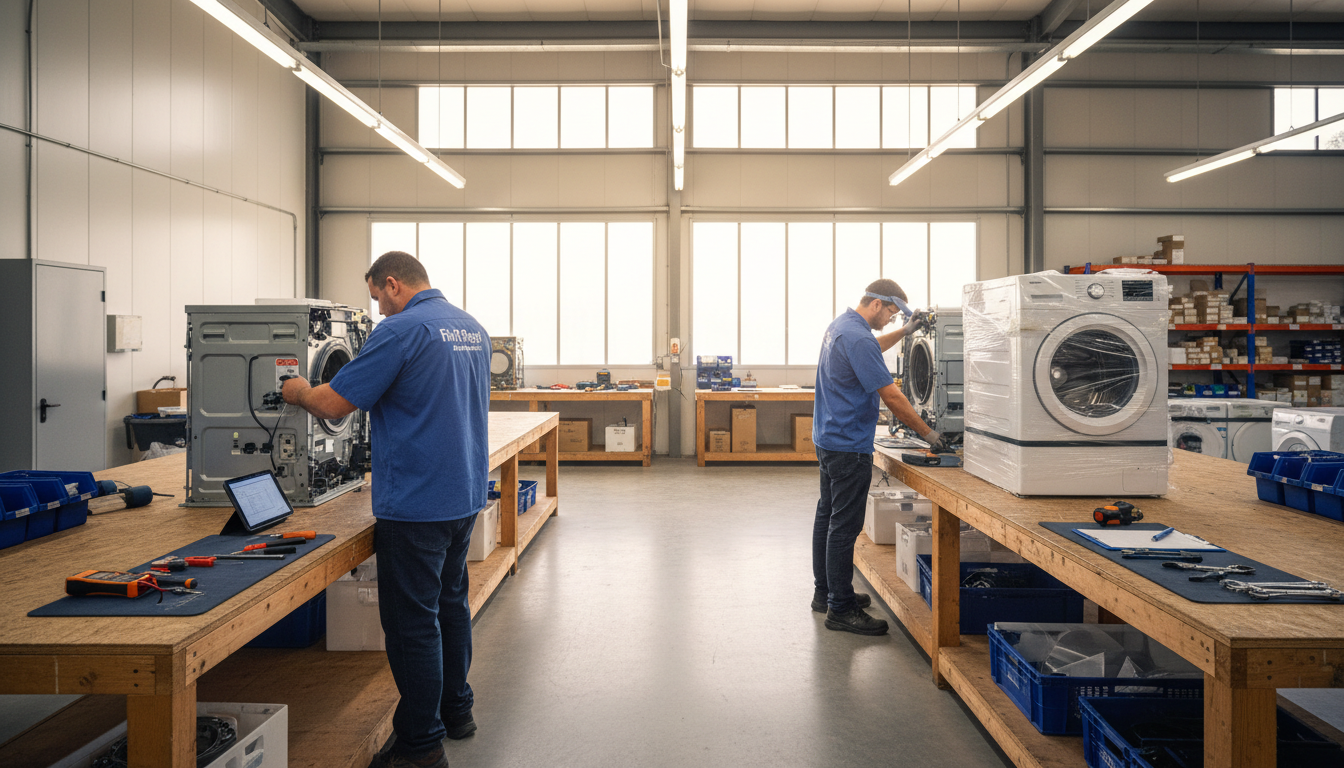
Which lasts longer: a refurbished appliance with replaced parts or a factory second with cosmetic damage but brand-new components? For Queensland buyers comparing refurbished appliances for sale against factory seconds appliances, longevity matters as much as upfront savings. Understanding how manufacturing standards, component condition, and usage history affect lifespan helps you choose an appliance that delivers reliable performance for years, not just months.
At Smart Electrical Clearance Outlet, we stock both refurbished appliances for sale and factory seconds appliances across our Mt Ommaney, Capalaba, Strathpine, and Helensvale stores. Before understanding the core differences between refurbished and factory seconds appliances, buyers need practical guidance on which category offers better long-term durability for their Queensland home.
Appliance longevity depends on three primary factors: component quality at manufacture, usage history, and maintenance standards. Factory seconds appliances are brand-new units with minor cosmetic imperfections like scratches, dents, or packaging damage that occurred during manufacturing or transport. All internal components are unused and manufactured to the same standards as full-price models. Refurbished appliances are previously used units that have been repaired, tested, and restored to working condition, meaning some components may be original while others have been replaced.
The Australian Bureau of Statistics (ABS) reports the average Australian household replaces major appliances every 10-15 years, with refrigerators and washing machines among the longest-lasting categories. Factory seconds typically match this expected lifespan because they contain identical components to new appliances. Refurbished longevity varies based on the appliance’s age before refurbishment, which components were replaced, and the quality of repairs performed.
Under Australian Consumer Law (ACL) Schedule 2 of the Competition and Consumer Act 2010 (Cth), both factory seconds and refurbished appliances must meet mandatory statutory warranties including acceptable quality and fitness for purpose. The Australian Competition and Consumer Commission (ACCC) states that consumer guarantees under Australian Consumer Law apply for a reasonable time based on the price paid and expected lifespan, typically 5-10 years for major appliances. This legal protection applies regardless of whether an appliance is new, factory second, carton damaged (packaging damage only), or refurbished (repaired and tested).
Factory seconds appliances deliver the same expected lifespan as brand-new models because they’re manufactured to identical standards with unused components. A factory second LG refrigerator with a dented door panel contains the same compressor, evaporator, and control systems as a full-price unit. The cosmetic imperfection that classified it as a factory second doesn’t affect internal mechanisms or durability.
Manufacturing date significantly impacts longevity potential. Factory seconds should ideally be current-year or previous-year models maximum, ensuring components haven’t sat unused for extended periods. Compliance plates on appliances display manufacturing dates, allowing buyers to verify freshness. Newer models also meet current Energy Efficiency Labelling requirements under the Greenhouse and Energy Minimum Standards Act 2012 (Cth), which according to Energy Rating Australia can save Queensland households $200-400 annually compared to older models.
Storage conditions before sale can affect factory seconds longevity. Appliances stored in climate-controlled warehouses maintain component integrity better than units exposed to humidity or temperature extremes. Reputable retailers like Smart Electrical test and grade all factory seconds stock before sale, verifying that cosmetic damage hasn’t compromised functionality. This testing process identifies any units where external damage affected internal components, removing them from factory seconds classification.
Refurbished appliances can deliver reliable longevity if professionally repaired with quality components, but durability depends heavily on repair history. An appliance refurbished due to a single failed component like a door seal or control board may perform well for years. Units refurbished after multiple failures or extensive use show higher risk of additional component failures as original parts continue aging.
Component replacement quality determines refurbished longevity. Genuine manufacturer parts maintain original performance standards, while aftermarket components vary in quality and compatibility. Buyers should request details on which components were replaced during refurbishment and whether genuine or aftermarket parts were used. Critical components like compressors in refrigerators, motors in washing machines, and heating elements in dryers significantly impact lifespan when replaced.
Usage history before refurbishment affects remaining component life. An appliance used for two years in a single household typically has more remaining lifespan than a five-year rental property unit that experienced heavy use. Refurbished appliances from commercial settings like hotels or laundromats may have accumulated significantly more operating hours than residential units of similar age. Reputable retailers disclose usage history when known, helping buyers assess longevity potential.
Testing standards during refurbishment vary between retailers. Comprehensive testing includes running full cycles, checking temperature accuracy, verifying all functions, and inspecting internal components for wear. Basic testing may only confirm the appliance powers on and completes a single cycle. Buyers should ask what testing protocols were applied during refurbishment to gauge quality assurance standards.
Both factory seconds and refurbished appliances are protected by mandatory statutory warranties under Australian Consumer Law (ACL) Schedule 2 of the Competition and Consumer Act 2010 (Cth). These consumer guarantees require that goods must be of acceptable quality, fit for purpose, and match descriptions provided at sale. The Australian Competition and Consumer Commission (ACCC) and Queensland Office of Fair Trading enforce these rights across all appliance categories regardless of whether units are new, factory seconds, or refurbished.
Warranty coverage periods often differ between factory seconds and refurbished appliances. Factory seconds typically receive manufacturer warranties similar to new appliances, ranging from one to five years depending on brand and appliance type. Some manufacturers offer full warranties on factory seconds, while others provide limited coverage excluding cosmetic damage. Understanding warranty coverage on factory seconds appliances helps buyers assess long-term protection.
Refurbished appliances commonly receive shorter warranty periods than factory seconds, often three to twelve months, reflecting uncertainty about remaining component life. Some retailers offer extended warranties on refurbished units for additional cost. Warranty documentation should specify what’s covered, including parts, labour, and whether in-home service is included. Buyers should confirm warranty terms in writing before purchase.
Inspecting factory seconds before purchase reveals longevity indicators that confirm the unit will deliver expected lifespan. Following a pre-purchase inspection checklist for factory seconds ensures cosmetic damage hasn’t compromised internal components or functionality.
Cosmetic damage location matters for longevity assessment. Dents or scratches on external panels rarely affect performance, while damage near vents, seals, or control panels warrants closer inspection. Buyers should verify that cosmetic imperfections haven’t compromised insulation in refrigerators or structural integrity in washing machines. Retailers should clearly identify the nature and location of cosmetic damage before purchase.
Refurbished appliances require more thorough inspection than factory seconds because usage history and repair quality directly impact longevity. Knowing what to inspect when buying second-hand or refurbished fridges applies across all refurbished appliance categories.
Component condition reveals longevity potential in refurbished appliances. Worn drum bearings in washing machines, corroded evaporator coils in refrigerators, or frayed wiring indicate units nearing end of life despite refurbishment. Buyers should request to see the appliance operating through a complete cycle, checking for vibration, noise, and proper function. Refrigerators should reach target temperature within specified timeframes, while washing machines should complete cycles without error codes.
Factory seconds typically outlast refurbished appliances because all components are new and manufactured to current quality standards. Modern appliances from brands like LG, Samsung, Electrolux, and Westinghouse undergo rigorous quality control during manufacturing, with components tested to meet Australian standards. A factory second Samsung refrigerator contains the same compressor, evaporator, and control systems as a full-price model, manufactured on the same production line to identical specifications.
Component wear in refurbished appliances creates longevity uncertainty. Even when major components like compressors or motors are replaced during refurbishment, supporting components like wiring, sensors, and control boards remain original and continue aging. Mixed component ages mean refurbished appliances may experience cascading failures as original parts reach end of life while replaced components remain functional. This unpredictability makes longevity harder to estimate compared to factory seconds with uniformly new components.
Manufacturing advances improve factory seconds longevity over older refurbished models. Current appliances incorporate improved materials, more efficient motors, and better corrosion resistance than models from five or ten years ago. A factory second from current production may outlast a recently refurbished older model due to these manufacturing improvements. Energy Rating Australia confirms that newer models meeting current Minimum Energy Performance Standards (MEPS) under the Greenhouse and Energy Minimum Standards Act 2012 (Cth) also deliver better efficiency alongside improved durability.
Long-term costs extend beyond purchase price to include energy consumption, maintenance, and repair expenses over appliance lifespan. Factory seconds typically deliver lower total cost of ownership because new components require less maintenance and current energy ratings reduce running costs. Understanding energy efficiency considerations in factory seconds helps buyers calculate long-term savings.
Energy efficiency significantly impacts long-term costs for refrigerators, washing machines, and dryers. According to Energy Rating Australia, appliances meeting current Minimum Energy Performance Standards (MEPS) under the Greenhouse and Energy Minimum Standards Act 2012 (Cth) can save Queensland households $200-400 annually compared to older models. Factory seconds carry current energy ratings identical to new appliances, while refurbished units retain their original ratings which may be less efficient if the appliance is several years old.
| Cost Factor | Factory Seconds | Refurbished |
|---|---|---|
| Purchase Price | Moderate discount from retail | Larger discount from retail |
| Energy Efficiency | Current energy rating, lower running costs | Original rating, potentially higher running costs if older model |
| Maintenance Needs | Minimal during warranty period | Higher risk of component failures requiring repair |
| Warranty Coverage | Typically 1-5 years manufacturer warranty | Typically 3-12 months retailer warranty |
| Expected Lifespan | 10-15 years matching new appliances | Variable, 5-10 years depending on age and repairs |
| Total Cost of Ownership | Lower over 10-year period | Potentially higher due to repairs and energy costs |
Repair costs disproportionately affect refurbished appliances because aging components increase failure risk. A refurbished washing machine may require bearing replacement, control board repair, or pump replacement within a few years, with each repair costing several hundred dollars. Factory seconds rarely require repairs during their first five to seven years, with costs covered by warranty if failures occur. Buyers should factor potential repair expenses into total cost calculations when comparing purchase prices.
Certain appliance categories perform better as factory seconds while others tolerate refurbishment well, depending on component complexity and wear patterns. Understanding which types deliver best longevity in each category helps buyers make informed choices.
Refrigerators and freezers perform best as factory seconds because compressor longevity determines overall lifespan. Compressors are sealed systems that rarely fail when new but become increasingly unreliable with age and use. A factory second Hisense or Electrolux refrigerator with a new compressor typically delivers 12-15 years of reliable service, while a refurbished unit with original compressor carries higher failure risk even if other components were replaced. According to Energy Rating Australia, refrigerator lifespan depends primarily on compressor quality and usage patterns, favouring factory seconds with unused components.
Washing machines show moderate performance as refurbished appliances if drum bearings, motors, and pumps were replaced during refurbishment. These high-wear components determine washing machine longevity, so comprehensive refurbishment can restore performance approaching new condition. However, factory seconds washing machines from brands like LG, Samsung, or Panasonic still offer more predictable longevity because all components including suspension systems, door seals, and control electronics are new.
Dryers tolerate refurbishment relatively well because they have fewer moving parts than washing machines and simpler mechanical systems. Heating elements and thermostats are easily replaced during refurbishment, and drum motors experience less stress than washing machine motors. Factory seconds dryers still offer longer expected lifespan, but the longevity gap between factory seconds and quality refurbished dryers is narrower than for refrigerators or washing machines.
Dishwashers perform poorly as refurbished appliances because pump seals, spray arms, and control valves experience significant wear during use. These components are expensive to replace during refurbishment, so many refurbished dishwashers retain original parts that may fail within a few years. Factory seconds dishwashers from Electrolux, AEG, or Westinghouse deliver substantially longer lifespan with new pumps and seals.
Choosing between factory seconds and refurbished appliances requires balancing upfront budget against long-term value. Factory seconds offer better longevity and lower total cost of ownership over 10-15 years, making them ideal for permanent homes where appliances will see daily use for a decade or more. Refurbished appliances suit shorter-term needs like rental properties, temporary accommodation, or situations where budget constraints make factory seconds unaffordable.
Buyers prioritising longevity should choose factory seconds for critical appliances like refrigerators that run continuously and where failure causes immediate inconvenience. The predictable lifespan and comprehensive warranty coverage justify the moderate price premium over refurbished units. For less critical appliances or shorter-term needs, quality refurbished units from reputable retailers offer acceptable performance at lower upfront cost.
Smart Electrical stocks both categories across our Mt Ommaney, Capalaba, Strathpine, and Helensvale stores, with all units tested and graded before sale. Our team provides transparent information about appliance history, repair details for refurbished units, and warranty coverage to help buyers make informed decisions. Asking essential questions to ask before purchasing ensures you understand exactly what you’re buying and what longevity to expect.
Queensland buyers should consider climate factors when assessing longevity. High humidity in coastal areas like Helensvale accelerates corrosion in appliances with metal components, making factory seconds with new corrosion-resistant materials preferable to older refurbished units. Inland areas with lower humidity see less climate impact on appliance longevity, making quality refurbished units more viable.
Yes, factory seconds appliances typically have the same expected lifespan as brand new models because they’re manufactured to identical standards with the same components. The cosmetic imperfections that classify them as factory seconds don’t affect internal mechanisms or durability. Under Australian Consumer Law (ACL) Schedule 2 of the Competition and Consumer Act 2010 (Cth), factory seconds must still meet mandatory statutory warranties including acceptable quality and fitness for purpose.
Refurbished appliances can be equally reliable if professionally repaired, but longevity depends on the quality of repairs, which components were replaced, and the appliance’s usage history before refurbishment. Factory seconds have never been used, so all components are new and haven’t experienced wear. Both are protected by mandatory statutory warranties under ACL, though the nature of coverage may differ based on the retailer’s warranty terms.
Refurbished appliances sold in Queensland are protected by mandatory statutory warranties under Australian Consumer Law (ACL), which guarantee goods must be of acceptable quality and fit for purpose. Retailers may also offer additional commercial warranties. The Australian Competition and Consumer Commission (ACCC) confirms these ACL rights apply regardless of whether an appliance is new, factory second, or refurbished, though warranty periods may vary by retailer.
A factory second fridge typically lasts longer because all components are new and unused, whereas a refurbished fridge has previous operating hours and may have replaced parts alongside original components. According to Energy Rating Australia, refrigerator lifespan depends primarily on compressor quality and usage patterns. Factory seconds offer predictable longevity matching new appliances, while refurbished longevity varies based on repair quality and component age.
Yes, Energy Efficiency Labelling requirements under the Greenhouse and Energy Minimum Standards Act 2012 (Cth) apply to all appliances sold in Australia, including factory seconds and refurbished models. The energy rating label must accurately reflect the appliance’s tested performance. Factory seconds have identical energy performance to new models, while refurbished appliances maintain their original rating unless components affecting efficiency were replaced.
Browse refurbished appliances for sale and factory seconds appliances at Smart Electrical across Mt Ommaney, Capalaba, Strathpine, and Helensvale
All stock tested, graded, and backed by warranty. Shop in-store across South East Queensland or order online.

ATOZ 2020 PTY LTD T/A Smart Electrical Clearance Outlet Brisbane
South East Queensland’s Largest Appliance Clearance Outlet for LG, Samsung, Hisense, Westinghouse, Fisher & Paykel, Electrolux, Haier, TCL, Toshiba (TV’s only), AEG and Vintec.
© 2026 SMART ELECTRICAL OUTLET BRISBANE | ATOZ 2020 Pty Ltd
Smart Electrical Brown Plains – Grand Plaza (Near Kmart)
A: Shop G105/27-49 Browns Plains Rd, Browns Plains QLD 4118
P: (07) 3800 1013
E: **@**********om.au
Smart Electrical Mt Ommaney – Mount Ommaney Centre (Inbetween JB HI FI and Best & Less)
A: Shop 56/171 Dandenong Rd, Mount Ommaney QLD 4074
P: (07) 3376 7445
P: 0451 068 031 (Temporary Store Phone)
E: **@**********om.au
Smart Electrical Capalaba – Capalaba Central Shopping Centre (Near Pacific Smiles Dental at the BIG W Entrance)
A: Shop 50-51/38/62 Moreton Bay Rd, Capalaba QLD 4157
P: (07) 3823 4165
E: **@**********om.au
Smart Electrical Strathpine – Strathpine Centre (Near Target)
A: Shop 148/295 Gympie Rd, Strathpine QLD 4500
P: 0451 729 237
E: **@**********om.au
Helensvale Smart Electrical – Westfield Helensvale (In Front of Aldi, near Concierge Desk)
A: 1, Shop 1094/29 Millaroo Dr, Helensvale QLD 4212
P: 0461 322 434
E: **@**********om.au
Mon – Fri: 9:00 AM – 5:00 PM
Thu: 9:00AM – 8:00PM
Sat: 9:00 AM – 4:30PM
Sun: 10:00 AM – 4:00 PM
Opening times may vary store to store, please check with the individual Smart Electrical Clearanace Outlet Stores Locations for exact opening times.


© 2026 Smart Electrical Outlet. | Terms & Conditions | Privacy Policy | All Rights Reserved | Website by SWE
Sign up to the Smart Electrical newsletter and receive a $10 store coupon for your next purchase.

 | Thank you for Signing Up |