


How to Choose the Right Washing Machine for Your Home
Compare washing machine types, capacities and useful features so you can find a model that suits your laundry, household and washing routine.
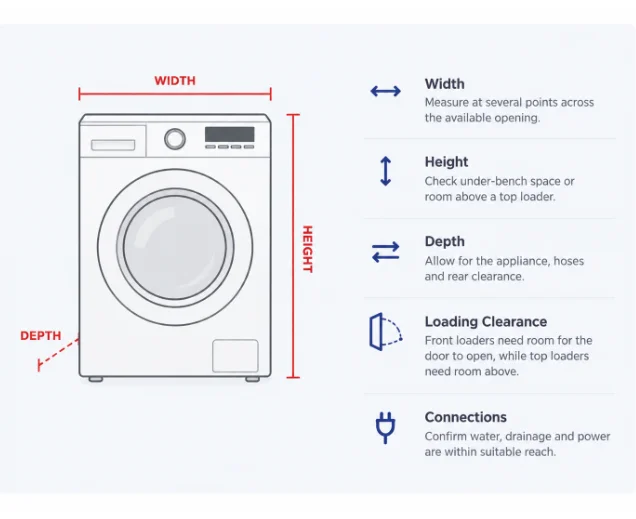
Measure before comparing models. A washing machine needs to fit the laundry space, connect correctly and still allow comfortable loading access.
Width – measure the available opening at several points.
Height – check under-bench space or clearance above a top loader.
Depth – allow for hoses and fittings behind the machine.
Loading clearance – allow the front door or top lid to open fully.
Connections – check water, drainage and power are within suitable reach.
Measure loading clearance as well as the appliance cavity. A front loader needs room for the door to swing open, while a top loader needs clear space above the lid.
Household size isn’t everything.
Bedding, towels, workwear and sports gear can justify a larger capacity even in a smaller household.
Use capacity as a starting point, then adjust for how often you wash, whether you regularly wash bedding and how large your typical loads are.
Household Starting Capacity Worth Considering
1–2 people 6–7.5kg Everyday or compact loads
2–3 people 7.5–8.5kg Regular household washing
3–4 people 8.5–10kg Family loads, towels and bedding
5+ people 10kg+ Larger or bulk washing loads
The best format depends on your laundry space, loading preference, wash habits and whether you also need drying.
A front-opening drum that can suit under-bench laundries and households wanting broad program choice and fabric-care features.
Loads from above, making it convenient for people who prefer standing-height access and a straightforward everyday laundry routine.
Combines washing and drying in one appliance footprint, making it useful where there is no room for a separate dryer.
A vertically integrated washer and dryer system with separate drums, giving you dedicated washing and drying without using extra floor width.
A smaller-capacity format for lighter loads or laundries where full-size dimensions are difficult to accommodate.
A quick way to compare the formats that best match your laundry, loading preference and drying needs.
| Washer Type | Typical Capacity | Loading Style | Best For | Key Consideration |
|---|---|---|---|---|
| Front Loader | 6kg–12kg+ | Front | Under-bench layouts and flexible programs | Door swing and appliance depth |
| Top Loader | 6kg–14kg+ | Top | Easy standing-height loading | Clearance above the lid |
| Washer Dryer Combo | Varies by model | Front | One-appliance wash and dry convenience | Dry capacity may be lower than wash capacity |
| Laundry Centre | Varies by unit | Front | Separate wash and dry functions in a vertical setup | Overall height and installation access |
| Compact Washer | Generally smaller capacity | Varies | Limited spaces and lighter loads | Confirm actual width, depth and capacity |
Focus on features that match the way your household actually washes rather than simply choosing the machine with the longest program list.
Useful for smaller or lightly soiled loads when you need a faster turnaround.
Selected machines include steam-assisted or hygiene-focused cycles for specific laundry needs.
Compatible models can automatically dispense detergent, reducing the need to measure every load manually.
Some washers offer app controls, cycle notifications, diagnostics or additional downloadable programs.
Compare the programs you will actually use, such as bedding, wool, delicates, sportswear or baby care.
Selected models can adjust water or cycle behaviour based on the load, helping automate everyday washing.
The right capacity depends on how much laundry you normally wash, not household size alone. Smaller households may suit a 7kg to 8kg washer, while families or households regularly washing towels and bedding may benefit from 9kg, 10kg or larger models.
Neither format is automatically better. Front loaders can suit under-bench installations and are often chosen for water efficiency and fabric care, while top loaders provide convenient standing-height access and can suit households that prefer loading from above.
Measure the available width, height and depth, then allow room for hoses and fittings. Front loaders also need door-opening clearance, while top loaders need enough space above the lid.
Capacity is measured in kilograms and refers to the amount of dry laundry the machine is designed to wash in a rated load. Use the figure as a guide and consider bulky items such as bedding and towels as well.
A washer dryer combo can be useful when you want washing and drying in one appliance footprint. Check the wash and dry capacities separately because the drying capacity is commonly lower than the washing capacity.
Higher spin speeds can remove more water from suitable fabrics before the wash finishes, which can reduce later drying time. Adjustable spin settings are useful because delicate loads may need gentler treatment.
Check the individual appliance condition, capacity, loading type, door or lid, controls, drum, detergent drawer, exterior panels, included accessories and applicable warranty information before buying.
Compare current washing machines, capacities, loading types, brands and available stock online or visit your nearest Smart Electrical store.
View warranty information ➜


© 2026 Smart Electrical Outlet. | Terms & Conditions | Privacy Policy | All Rights Reserved | Website by SWE