


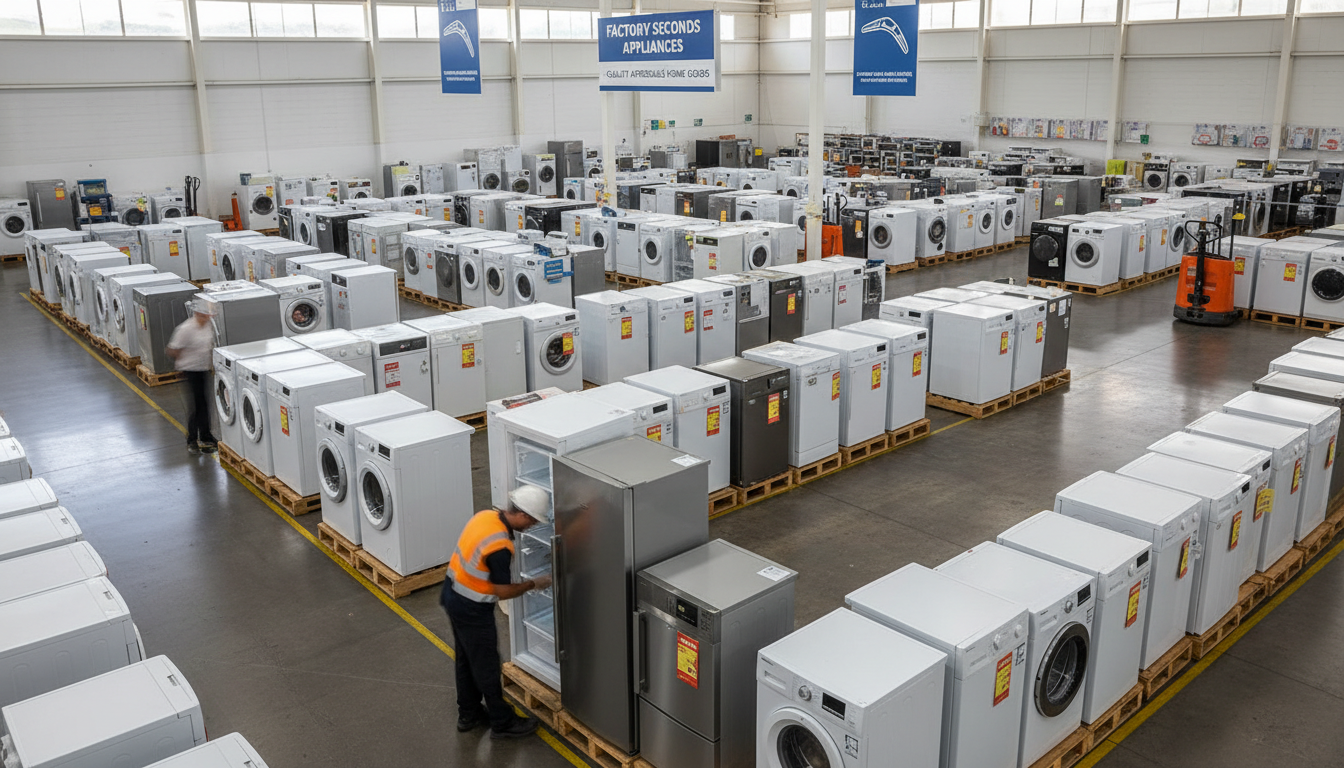
You’ve seen the advertised price on a brand-new fridge at a big box retailer. Then you spot the same model at a factory seconds sale for 40% less. The appliance looks nearly identical, works exactly the same, and comes with warranty coverage. So what actually drives that price difference, and why can factory seconds retailers discount so heavily without cutting corners on quality or consumer protections.
Understanding what factory seconds actually are is the starting point, but Queensland buyers searching for a factory seconds sale want to know the economics behind the discount. This explainer breaks down the real cost structures, overhead differences, and pricing models that allow factory seconds outlets to offer genuine savings while maintaining full compliance with Australian Consumer Law (ACL) Schedule 2 of the Competition and Consumer Act 2010 (Cth) and mandatory statutory warranties under ACL.
A factory second is a brand-new appliance that has never been used but carries a minor cosmetic imperfection that prevents it from being sold as retail stock. These imperfections occur during manufacturing or transport and typically include small scratches, dents on side panels, minor paint blemishes, or packaging damage that affects the carton but not the appliance itself.
The Queensland Office of Fair Trading notes that factory seconds and clearance appliances must meet the same safety and performance standards as retail stock under Australian Consumer Law. The cosmetic issue does not affect functionality, energy efficiency, or warranty coverage. A factory second LG refrigerator with a small dent on the side panel will cool food exactly as effectively as the retail version, maintain the same energy rating registered with Energy Rating Australia, and carry the same manufacturer warranty period.
Manufacturers cannot sell these units through traditional retail channels because retailers demand pristine presentation for showroom display and customer expectations. Rather than scrap functional appliances over minor cosmetic issues, manufacturers sell factory seconds stock to specialist retailers at significantly reduced wholesale prices. These savings are then passed to buyers.
Manufacturers face a straightforward economic calculation. A washing machine with a small scratch on the control panel cannot be sold through Harvey Norman or The Good Guys at full retail price, but scrapping the unit means losing the entire manufacturing cost. Selling it as a factory second recovers most of the production investment while clearing warehouse space for new stock.
The wholesale discount manufacturers offer to factory seconds retailers typically ranges from 30% to 60% below standard wholesale pricing, depending on the severity and visibility of the cosmetic issue. A dent on the back panel of a fridge that will never be seen once installed against a wall commands a smaller discount than a visible scratch on a stainless steel door. Manufacturers grade stock internally before releasing it to factory seconds channels.
This pricing model benefits everyone involved. Manufacturers recover costs and avoid waste. Factory seconds retailers acquire stock at prices that allow competitive retail pricing while maintaining viable margins. Buyers access premium brands like Samsung, Electrolux, and Panasonic at prices comparable to budget brands in the retail market. The benefits of buying factory seconds extend beyond simple price reduction to include access to higher-quality appliances within tighter budgets.
Factory seconds, clearance stock, and refurbished appliances all offer discounted pricing, but the reasons for the discount and the condition of the appliance differ significantly. Understanding these distinctions helps buyers make informed decisions and set appropriate expectations.
Factory seconds are brand-new appliances with cosmetic imperfections only. They have never been installed, used, or returned. The internal components, electronics, and mechanical systems are untouched and perform exactly as designed. Energy Efficiency Labelling requirements under the Greenhouse and Energy Minimum Standards Act 2012 (Cth) apply without modification because the appliance is functionally identical to retail stock.
Clearance stock includes discontinued models, excess inventory, or end-of-line products that manufacturers or retailers need to move quickly. These appliances are typically brand new with no cosmetic damage, but the model has been superseded by a newer release or the retailer is making space for incoming stock. Clearance pricing reflects supply chain factors rather than product condition.
Refurbished appliances have been previously sold, returned, repaired if necessary, and tested to confirm they meet manufacturer specifications. A refurbished dishwasher may have been returned due to buyer’s remorse, a minor fault that was subsequently repaired, or an installation issue unrelated to the appliance itself. Reputable retailers including Smart Electrical clearly disclose refurbished status and provide detailed information about what repairs or testing occurred. The difference between factory seconds versus refurbished appliances matters for warranty coverage and expected lifespan.
The price difference between a retail store and a factory seconds sale reflects fundamentally different business models and cost structures. Breaking down these costs reveals why the same appliance can carry vastly different price tags depending on where you buy it.
A traditional retail appliance store operates with substantial fixed costs. Premium showroom locations in shopping centres command high rent. Sales staff work on commission structures that incentivise higher-value transactions. Stores maintain extensive display stock that occupies floor space without generating immediate revenue. Marketing budgets cover television advertising, catalogue printing, and promotional campaigns. All these costs are built into the retail price you pay.
Factory seconds outlets operate with significantly lower overhead. Showroom presentation is functional rather than aspirational, reducing fit-out and maintenance costs. Sales staff typically work on salary rather than commission, lowering labour costs per transaction. Stock turnover is faster because pricing is more competitive, reducing inventory holding costs and warehouse space requirements. Marketing focuses on digital channels and word-of-mouth rather than expensive mass media campaigns.
The wholesale acquisition cost also differs dramatically. A retail store might pay $800 wholesale for a washing machine it sells at $1,400 retail. A factory seconds outlet might acquire the same model with a minor cosmetic imperfection for $500 wholesale and sell it at $850. The buyer saves $550, the retailer maintains a viable margin, and the manufacturer recovers most of its production cost rather than scrapping the unit.
The operational model of a factory seconds retailer differs from traditional appliance stores in several key ways, each contributing to lower overhead costs that translate directly into lower prices for buyers.
Location strategy plays a significant role. Factory seconds outlets often operate in shopping centres with lower rental costs compared to flagship retail locations, or in standalone warehouses with combined showroom and storage space. Smart Electrical operates across South East Queensland at Mt Ommaney (Mount Ommaney Centre), Capalaba (Capalaba Central), Strathpine (Strathpine Centre), and Helensvale (Westfield Helensvale), balancing accessibility for buyers with cost-effective lease arrangements. Understanding how clearance outlets operate in Queensland reveals the local factors that influence pricing and availability.
Inventory management focuses on rapid turnover rather than extensive display stock. Factory seconds retailers acquire stock opportunistically when manufacturers have surplus, rather than maintaining comprehensive model ranges across every brand. This reduces capital tied up in inventory and minimises storage costs. Stock arrives pre-graded from manufacturers, reducing inspection time and allowing faster pricing and sale.
Staffing models emphasise product knowledge and customer service over high-pressure sales tactics. Without commission structures that incentivise upselling, sales staff can focus on matching buyers with appropriate appliances based on actual needs rather than margin considerations. This approach builds customer trust and generates repeat business and referrals, reducing the need for expensive advertising campaigns.
Marketing budgets prioritise cost-effective digital channels, local community engagement, and organic search visibility over mass media advertising. A factory seconds retailer can reach Queensland buyers searching for specific appliances through targeted online content and local presence without the expense of television commercials or full-page newspaper advertisements.
The most common concern Queensland buyers express about factory seconds sales is whether lower prices mean reduced warranty coverage or fewer consumer protections. The answer is straightforward: mandatory statutory warranties under ACL apply to all consumer goods sold in Australia regardless of price, condition disclosure, or retailer disclaimers.
Australian Consumer Law (ACL) Schedule 2 of the Competition and Consumer Act 2010 (Cth) establishes consumer guarantees that cannot be excluded, restricted, or modified by retailers. These guarantees include that goods must be of acceptable quality, fit for purpose, match descriptions provided, and come with clear title. A factory second fridge purchased at a 40% discount carries exactly the same consumer guarantees as an identical model purchased at full retail price from a big box store.
Manufacturer warranties also apply to factory seconds in most cases. Brands including LG, Samsung, Electrolux, and Hisense typically provide the same warranty period for factory seconds as for retail stock, though buyers should confirm specific terms before purchase. These warranties are separate from and additional to the mandatory statutory warranties under ACL. Understanding warranty coverage on factory seconds helps buyers recognise that they maintain full legal protections despite the discounted price.
The Queensland Office of Fair Trading enforces these consumer protections and provides dispute resolution services if issues arise. Retailers cannot avoid warranty obligations by labelling goods as factory seconds, clearance, or sold as-is. The cosmetic imperfection that creates the factory second designation must be clearly disclosed before sale, but it does not void or reduce warranty coverage for functional defects.
Kitchen appliances consistently appear in factory seconds and clearance channels at higher volumes and deeper discounts than other appliance categories. Several factors drive this pattern, creating particularly strong value opportunities for Queensland buyers renovating or upgrading kitchens.
Packaging size and fragility contribute significantly. Ovens, dishwashers, and rangehoods arrive in large cartons that are more susceptible to cosmetic damage during transport and warehouse handling. A small forklift contact that dents a carton corner may leave a corresponding mark on the appliance panel, creating a factory second that functions perfectly but cannot be sold as retail stock. The larger the carton, the higher the probability of minor transport damage.
Model turnover in kitchen appliances occurs more frequently than in laundry or cooling categories. Manufacturers release new oven ranges, dishwasher models, and cooktop designs annually, creating regular clearance opportunities as retailers make space for incoming stock. A previous-year model oven offers identical cooking performance to the current release but may lack minor feature updates like smartphone connectivity or revised control panel layouts. Buyers who prioritise core functionality over the latest features can access substantial savings.
Installation visibility also affects clearance pricing. Built-in ovens and dishwashers sit within cabinetry where minor cosmetic imperfections on side panels or backs are completely hidden once installed. A dent that would be highly visible on a freestanding fridge becomes irrelevant on a built-in appliance. Manufacturers and retailers price these units more aggressively because the cosmetic issue has zero practical impact for the buyer.
Clearance kitchen appliances at Smart Electrical regularly include premium brands like AEG, Electrolux, and Westinghouse at prices comparable to budget brands in retail stores. A buyer planning a kitchen renovation can allocate their budget to higher-quality appliances by purchasing clearance or factory seconds stock, improving long-term performance and durability without exceeding their budget.
Reputable factory seconds retailers implement grading and inspection processes before pricing and selling stock. These checks confirm that cosmetic imperfections are accurately disclosed, functional performance meets manufacturer specifications, and buyers receive clear information about what they are purchasing.
Visual inspection identifies and documents all cosmetic imperfections. Staff examine each appliance systematically, noting the location, size, and visibility of scratches, dents, or paint blemishes. This documentation informs pricing decisions and provides transparency for buyers. A small scratch on the back panel of a washing machine warrants a smaller discount than a visible dent on the front of a dishwasher door.
Functional testing confirms that all features operate as designed. For refrigerators, this includes verifying that compressors cycle correctly, temperature controls respond appropriately, and door seals maintain proper closure. Washing machines are tested through complete wash cycles to confirm that motors, pumps, and electronic controls function correctly. Ovens are powered on to verify heating elements, thermostats, and control panels operate within specifications.
Energy rating verification ensures that the appliance carries the correct Energy Rating Label as required under the Greenhouse and Energy Minimum Standards Act 2012 (Cth). Factory seconds maintain the same energy efficiency as retail models because the cosmetic imperfection does not affect internal components or performance. Buyers can compare running costs using Energy Rating Australia data with confidence that a factory second will perform identically to the retail version.
Knowing what to inspect before purchasing helps buyers make informed decisions and set appropriate expectations about the condition of factory seconds stock.
Factory seconds sales provide value year-round, but certain buying scenarios and timing considerations maximise the benefit for Queensland buyers.
Major appliance purchases where cosmetic appearance is secondary to functionality represent ideal factory seconds opportunities. A second fridge for a garage, a washing machine for a laundry room with limited visibility, or a chest freezer for bulk storage all prioritise performance over pristine appearance. The 30-60% price difference becomes pure savings without any practical compromise.
Renovation and new build projects benefit from factory seconds pricing because installation often conceals minor cosmetic imperfections. Built-in ovens, integrated dishwashers, and under-counter refrigerators sit within cabinetry where side panel scratches or back panel dents are completely hidden. Buyers can allocate renovation budgets to higher-quality appliances or additional features by purchasing factory seconds stock.
Rental property fit-outs and investment property upgrades require balancing cost control with quality and reliability. Factory seconds from established brands like LG, Samsung, and Electrolux provide better long-term performance and lower maintenance costs than budget brands at similar price points. The cosmetic imperfection has no impact on tenant satisfaction or property presentation, while the lower acquisition cost improves return on investment.
End-of-financial-year periods and post-Christmas clearance events typically see increased factory seconds availability as manufacturers clear warehouses and retailers make space for new model releases. Stock selection is broader and pricing may be more aggressive during these periods, though quality factory seconds stock moves quickly once listed.
First-home buyers and young families working within tight budgets can access premium appliance brands through factory seconds channels that would be unaffordable at retail prices. The combination of lower purchase price and identical energy efficiency creates both immediate and ongoing savings. Exploring affordable appliance upgrades using factory seconds reveals how Queensland buyers can improve home functionality without budget strain.
Most factory seconds retailers including Smart Electrical price stock based on grading and condition, with limited room for negotiation. Prices already reflect 30-60% discounts compared to retail. Under Australian Consumer Law (ACL) Schedule 2 of the Competition and Consumer Act 2010 (Cth), all advertised prices must include mandatory statutory warranties regardless of negotiation.
Yes. Factory seconds are the same model as retail stock, so Energy Efficiency Labelling requirements under the Greenhouse and Energy Minimum Standards Act 2012 (Cth) apply identically. A factory second fridge with a 4-star energy rating performs exactly the same as the retail version. Energy Rating Australia provides comparison data for all registered models.
Kitchen appliances like ovens, dishwashers and rangehoods often have larger cartons prone to cosmetic damage during transport, creating more factory seconds stock. Retailers also clear discontinued models when manufacturers release new ranges. The Australian Competition and Consumer Commission (ACCC) notes that clearance pricing reflects supply factors, not performance defects.
All factory seconds sold in Queensland are covered by mandatory statutory warranties under ACL, which guarantee acceptable quality and fitness for purpose. Most retailers including Smart Electrical also provide manufacturer warranties ranging from 12 months to 5 years depending on the appliance category. The Queensland Office of Fair Trading enforces these protections.
Browse factory seconds fridges, washing machines, and clearance kitchen appliances with transparent grading and full ACL warranty protection at Smart Electrical across South East Queensland.
All stock tested, graded, and backed by warranty. Shop in-store across South East Queensland or order online.

ATOZ 2020 PTY LTD T/A Smart Electrical Clearance Outlet Brisbane
South East Queensland’s Largest Appliance Clearance Outlet for LG, Samsung, Hisense, Westinghouse, Fisher & Paykel, Electrolux, Haier, TCL, Toshiba, AEG and ChiQ
© 2026 SMART ELECTRICAL OUTLET BRISBANE | ATOZ 2020 Pty Ltd
Smart Electrical Brown Plains – GRAND PLAZA (Near Kmart)
A: Shop G105/27-49 Browns Plains Rd, Browns Plains QLD 4118
P: (07) 3800 1013
E: **@**********om.au
Smart Electrical Mt Ommaney – Mount Ommaney Centre (Near JB HI FI and Best & Less)
A: Shop 56/171 Dandenong Rd, Mount Ommaney QLD 4074
P: (07) 3376 7445
P: 0451 068 031 (Temporary Store Phone)
E: **@**********om.au
Smart Electrical Capalaba – CAPALABA CENTRAL (Near Pacific Smiles Dental at the BIG W Entrance)
A: Shop 50-51/38/62 Moreton Bay Rd, Capalaba QLD 4157
P: (07) 3823 4165
E: **@**********om.au
Smart Electrical Strathpine – STRATHPINE CENTRE (Near Target)
A: Shop 148/295 Gympie Rd, Strathpine QLD 4500
P: 0451 729 237
E: **@**********om.au
HELENSVALE SMART ELECTRICAL (Westfield Helensvale)
A: 1, Shop 1058/29 Millaroo Dr, Helensvale QLD 4212
P: 0461 322 434
E: **@**********om.au
Mon – Fri: 9:00 AM – 5:00 PM
Thu: 9:00AM – 8:00PM
Sat: 9:00 AM – 4:30PM
Sun: 10:00 AM – 4:00 PM
Opening times may vary store to store, please check with the individual Smart Electrical Clearanace Outlet Stores Locations for exact opening times.


© 2026 Smart Electrical Outlet. | Terms & Conditions | Privacy Policy | All Rights Reserved | Website by SWE
Sign up to the Smart Electrical newsletter and receive a $10 store coupon for your next purchase.

 | Thank you for Signing Up |


