


Induction cooktops can look straightforward to buy: choose the width, compare cooking zones, check the features and price. The electrical side is easier to overlook.
Before ordering, it is important to check the induction cooktop power requirements for the exact model and whether your home can support them. Rated power, connection method, circuit requirements and phase compatibility can all affect installation.
There is no single circuit size, amperage or power supply that applies to every induction cooktop. Check the manufacturer’s specifications first and have a licensed electrician assess the proposed appliance and existing installation where needed.
Different induction cooktops use different numbers of zones, boost functions and power-management systems, so their maximum connected loads can vary.
Cooktop width alone does not determine electrical demand. Two models with similar dimensions may have different rated power or connection requirements, which is why the specification sheet matters more than assumptions based on whether a cooktop is 60cm, 80cm or 90cm.
Before purchasing, check the manufacturer’s documentation for:
A useful current example is the LG BCI607T3BG 60cm Induction Cooktop. LG lists this specific model with a 7.4kW maximum absorbed power figure, 32A current figure and several manufacturer-supported power-limiter settings.
Those figures apply to that model only. They are not a general rule for other induction cooktops.
Some induction cooktops may require a dedicated circuit or another specific electrical arrangement, but buyers should not assume the same setup applies to every model.
An electrician may also need to consider the home’s existing circuits, switchboard, available supply and other significant electrical loads. This is particularly relevant in older homes or renovations where the existing installation was not designed around the proposed appliance.
In Queensland, electrical work in a home must be carried out by appropriately licensed electrical workers or contractors. See the Queensland electrical licensing information for official guidance.
Not all induction products connect to electricity in the same way. Portable units may use a conventional plug connection, while built-in cooktops can have different manufacturer-specified arrangements.
Phase compatibility is also model-specific. Some appliances support more than one supply configuration, while others have requirements that must be checked against the property.
Do not assume a cooktop is plug-in or hardwired based on size, or that a larger cooktop automatically needs multi-phase power. Check the exact installation manual and ask your electrician if the documentation is unclear.
Having an existing electric cooktop does not automatically mean any new induction model can be installed in its place.
The replacement may have a different connected load or installation requirement. A licensed electrician can assess the existing circuit, switchboard and supply against the specifications of the proposed model.
Depending on the property and appliance, electrical upgrades may be required. Checking before purchase can therefore prevent an unexpected installation issue after the cooktop has arrived.
Switching from gas to induction can require more planning because the kitchen may not already have an electrical supply suitable for the new cooktop.
Before ordering, consider:
During a renovation, these checks are best made before cabinetry, benchtops and appliance selections are finalised.
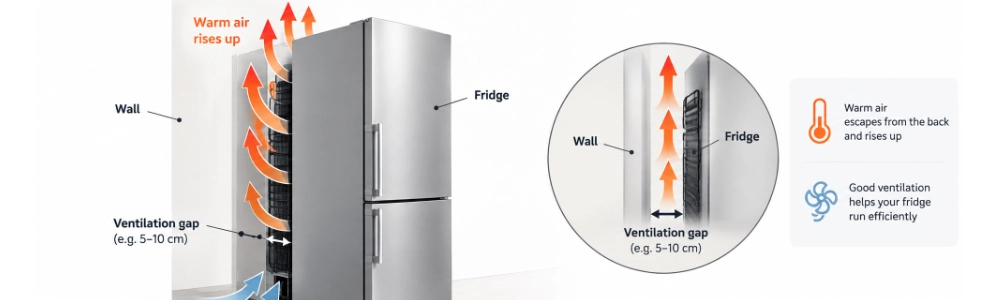
The space behind a fridge is not only about airflow.
Some induction cooktops include manufacturer-supported power-management or power-limiting functions.
For example, LG documentation for the BCI607T3BG lists several power-limiter settings below its maximum 7.4kW rating. This can provide configuration options where the manufacturer permits them.
Power management does not automatically make an appliance suitable for any circuit or property. The selected setting still needs to comply with the manufacturer’s instructions and suit the home’s electrical installation.
Before ordering:
For ongoing appliance care after installation, see the Smart Electronics Cooktops Care Guide.
The key thing to understand about induction cooktop power requirements is that there is no universal electrical setup that suits every appliance.
Before buying, look beyond width and cooking features. Check the rated load, voltage, connection requirements, phase information and any available power-management settings for the exact model.
If compatibility is uncertain, have a licensed electrician review the specifications before ordering. That can identify electrical work early rather than when installation is already underway.
It depends on the model. Check the manufacturer’s rated power, voltage, connection and phase information rather than relying on a universal figure.
Some models or installations may. Confirm the appliance documentation and have the home’s electrical installation assessed where required.
Some models support single-phase configurations, but this is model-specific. Check the manufacturer’s installation instructions.
Not every induction product connects in the same way. Check the exact model’s installation documentation rather than assuming.
Yes, but the electrical supply, circuit and switchboard should be checked first, and gas disconnection may also require an appropriately qualified professional.



© 2026 Smart Electrical Outlet. | Terms & Conditions | Privacy Policy | All Rights Reserved | Website by SWE