


A fridge can fit within the listed width of a kitchen cavity and still be unsuitable for the space.
That is because appliance dimensions are only part of the measurement. You may also need fridge ventilation clearance, room for doors and handles to move, access for plugs or water connections, and enough tolerance around surrounding cabinetry for installation.
There is no single clearance measurement that applies to every refrigerator. The correct gap depends on the brand, model and ventilation design, so the manufacturer’s installation specifications should always take priority.
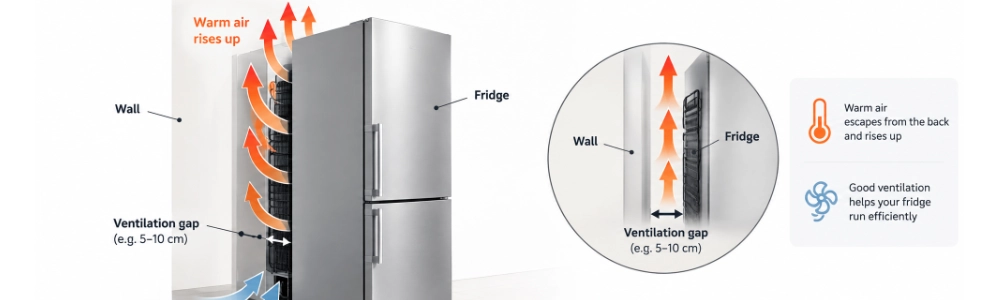
Fridges release heat as part of the cooling process and need suitable airflow around the appliance. The Australian Government’s Energy Rating guidance explains that restricted airflow from surrounding walls or cabinetry can make a refrigerator work less efficiently.
This is why a fridge that is technically narrower than the cavity does not automatically mean it will fit properly.
The answer is model-specific.
Manufacturers publish their own fridge clearance requirements for the top, sides and rear. Some models are designed for relatively tight cabinetry, while others require more room.
For example, Samsung Australia publishes refrigerator clearance guidance and directs customers to model-specific requirements.
LG’s GF-L500MBL is another useful example. The 835 mm-wide model is designed for an 850 mm alcove, while its installation guidance separately explains how the door position affects a snug or flush cabinetry fit.
The point is not to apply those measurements to another fridge. It is to show why fridge cabinet clearance must be checked model by model.
When measuring a cavity, compare the available space against the full installation requirements rather than only the fridge body dimensions.
Check:
An overhead cabinet can reduce top clearance, while a wall beside the fridge can restrict the door even when the appliance body fits comfortably.
Door clearance is separate from ventilation clearance.
French door and side-by-side fridges need particular attention because nearby walls or cabinetry can prevent the doors from opening far enough for full access to shelves or drawers.
The current Samsung SRS6100B side-by-side fridge listing, for example, includes door-open dimensions as part of its installation information.
This is why fridge width alone cannot tell you whether the appliance will work in the space.
Before buying, measure the cavity itself rather than using your existing fridge as the reference.
Once you know the usable measurements, you can compare suitable models in the current fridges and freezers range.
Larger door configurations deserve extra attention around walls, islands and cabinetry. French door and side-by-side models can both become restricted by a nearby wall.
If you are still comparing layouts, the French Door vs Bottom Mount Fridge guide explains how those configurations suit different kitchen spaces.
The space behind a fridge is not only about airflow.
Depending on the model, you may need room for a power plug or water connection. Always check the installation drawing rather than assuming listed product depth is the total space required.
An overly tight installation can restrict airflow and create practical problems.
Doors may strike nearby cabinetry, handles may not clear a wall, internal drawers may be difficult to remove, and rear connections may be harder to access.
The solution is not to add an arbitrary gap. Follow the clearance specified for the exact refrigerator you are considering.
Before placing an order, confirm four things:
For ongoing positioning and airflow advice after installation, see the Fridge & Freezer Care Guide.
The correct fridge ventilation clearance is not a universal number.
Measure the actual cavity, then check the installation requirements for the specific model you are considering. Allow separately for ventilation, rear connections and door movement.
A fridge being narrower than the cavity is only the first check.
It depends on the model. Check the manufacturer’s required side, top and rear clearances rather than relying on a universal measurement.
Many refrigerators require space around the appliance for airflow, but the amount and location vary by model. Follow the exact installation guide.
Rear clearance varies and may also need to accommodate a plug, water line or other connections.
Possibly, if the manufacturer allows it and there is still adequate ventilation and door clearance.
There is no universal figure. Check the manufacturer’s door-opening diagrams and make sure nearby walls or cabinetry do not prevent normal access.



© 2026 Smart Electrical Outlet. | Terms & Conditions | Privacy Policy | All Rights Reserved | Website by SWE