

A self-cleaning oven sounds like a convenient solution to stubborn grease, food splatters and baked-on residue. But not every cleaning system works the same way, and some still require considerable manual effort.
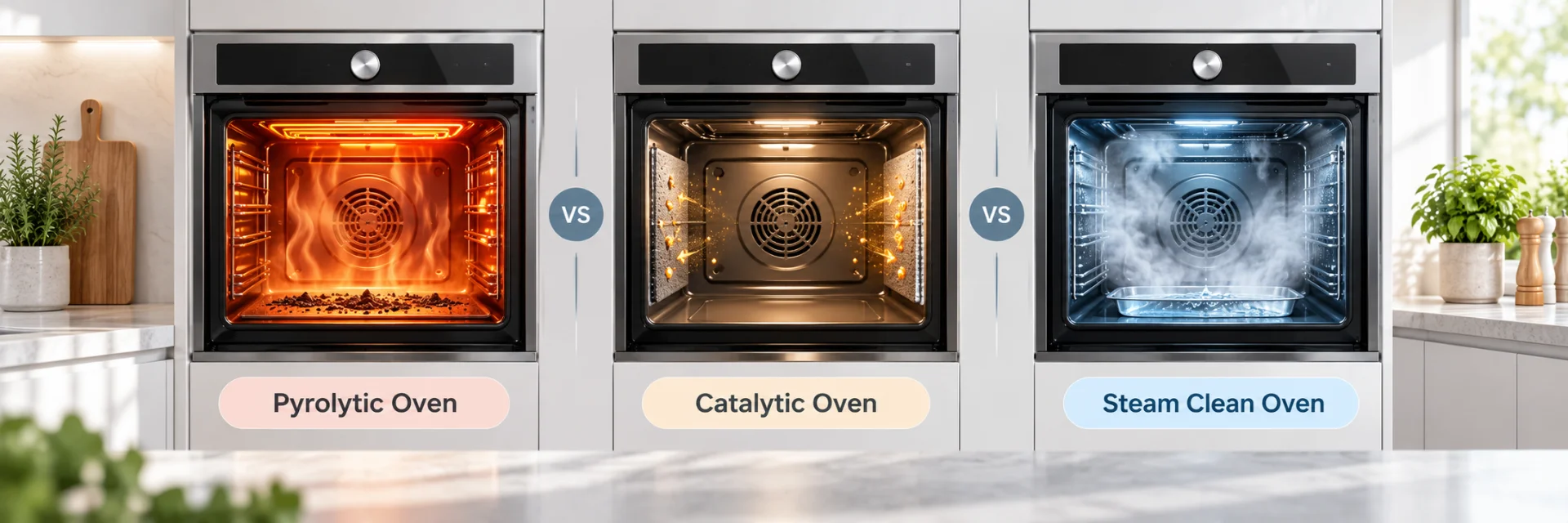
When comparing a pyrolytic vs catalytic oven, it’s also worth understanding steam-assisted cleaning. These three oven cleaning systems use different methods to reduce maintenance, with important differences in effectiveness, convenience and purchase price.
The real question isn’t simply which technology is best. It’s how much cleaning each system actually saves you, particularly if you cook frequently, roast greasy foods or prefer an oven that requires minimal scrubbing.
Here’s how the three main self-cleaning oven types compare.
| Feature | Pyrolytic | Catalytic | Steam Clean |
| Cleaning method | High heat reduces residue to ash | Treated liners break down grease | Moisture softens residue |
| Manual effort | Usually relatively low | Moderate | Wiping required |
| Heavy grease | Generally most effective | Effective on treated surfaces | Limited on baked-on residue |
| Oven floor | Usually cleaned during cycle | Often requires wiping | Requires wiping |
| Door glass | May need extra cleaning | Manual cleaning | Manual cleaning |
| Cleaning cycle | Dedicated high-heat program | Often works during heating | Assisted moisture-based cycle |
| Special maintenance | Remove ash and clean accessories | Care for catalytic liners | Remove residue and moisture |
| Best suited to | Heavy cooking and regular roasting | Regular cooking | Frequent light cleaning |
These are general characteristics. Individual ovens differ in cavity coverage, cleaning programs and manufacturer requirements.
Pyrolytic oven cleaning uses a dedicated high-temperature cycle to break down grease, food splatters and stubborn baked-on residue into fine ash.
After the oven cools, the remaining ash can usually be wiped away with a damp cloth.
This technology is particularly useful for people who regularly roast meat, bake at high temperatures or experience heavy grease buildup.
Because the cleaning cycle treats much of the oven cavity, pyrolytic cleaning generally requires less manual scrubbing than other methods.
However, there are limitations.
For example, Smart Electronics QLD lists the Samsung NV7B5775WAK 76L Pyrolytic Dual Cook Flex Oven, which includes a pyrolytic system designed to reduce cooking residue to ash. For households dealing with stubborn grease regularly, this level of cleaning assistance can be a worthwhile convenience.
Catalytic cleaning uses specially treated liners that help absorb and break down grease when the oven reaches suitable operating temperatures.
Unlike pyrolytic cleaning, the process generally works during normal cooking or through manufacturer-specified heating procedures rather than requiring an extreme-temperature deep-cleaning cycle.
The biggest limitation is coverage.
Catalytic liners may be fitted to the rear wall, side panels or selected cavity surfaces. Areas without the coating still require conventional cleaning.
For example, the Bosch Series 2 oven with EcoClean Direct uses a specialised rear-wall coating to reduce grease buildup. This illustrates why checking the exact coated surfaces matters.
Catalytic coatings also need appropriate maintenance. Abrasive products or unsuitable chemicals may damage them, and some liners eventually require replacement.
The advantage is ongoing cleaning assistance without regularly running a dedicated deep-cleaning cycle. However, catalytic technology should not be mistaken for an entirely self-cleaning oven.
A steam clean oven uses water and heat to help soften food residue, making it easier to remove.
Depending on the model, water may be added to the oven cavity or a dedicated reservoir before starting an assisted cleaning program.
Steam cleaning is particularly useful for light spills, fresh food residue and regular maintenance.
However, it generally doesn’t remove stubborn baked-on grease automatically. The user must still wipe the interior after the cycle.
An example is the LG BO609B2BG4 76L InstaView Series 9 Oven at Smart Electronics QLD. Its Blue EasyClean feature uses steam and specialised enamel to assist cleaning, with LG advertising a 10-minute process. Results depend on oven use and cleaning frequency.
Steam assistance can be useful for households that clean frequently and rarely allow residue to become heavily baked on.
An oven advertised with steam technology doesn’t necessarily include a steam-cleaning function.
Steam cooking adds moisture during food preparation to influence cooking results.
Steam cleaning uses moisture specifically to loosen residue for easier removal.
Some ovens offer both, while others provide steam cooking alongside pyrolytic cleaning. Always check the stated cleaning system rather than relying on the word steam in the product name.
Pyrolytic cleaning generally provides the most assistance with stubborn, baked-on residue. Catalytic liners reduce grease buildup on treated panels, while steam systems make ordinary wiping easier.
However, all three can leave some cleaning tasks.
Door glass, seals, racks, baking trays and areas outside the treated cavity may require attention.
For broader maintenance advice, read the Smart Electronics QLD Oven Care Guide, which covers everyday cleaning habits, door seals, racks and appropriate self-cleaning practices.
For households that frequently prepare roasts, fatty meats and other foods that leave difficult deposits, pyrolytic cleaning generally has the advantage.
Its high-temperature process treats stubborn residue more thoroughly than moisture-assisted wiping or catalytic coatings limited to selected surfaces.
Catalytic liners can help control grease buildup over time, but untreated areas still require cleaning.
Steam cleaning is better suited to regular light maintenance rather than infrequent deep cleaning.
It’s also worth considering your habits. Someone who wipes fresh spills promptly may have little need for an intensive pyrolytic cleaning cycle.
Pyrolytic cleaning requires a dedicated high-temperature cycle, which consumes electricity and keeps the oven unavailable for cooking during cleaning and cooling.
Catalytic liners generally work using heat produced during cooking or a specified maintenance procedure.
Steam-assisted programs typically involve a lighter cleaning process using water and heat.
However, there is no universal electricity cost for any of these systems. Consumption depends on the model, selected program and cleaning frequency.
Cleaning time should also be assessed alongside the manual work remaining. A longer automatic cycle may still be more convenient than scrubbing stubborn residue by hand.
Paying extra for pyrolytic cleaning makes the most sense when the feature will be used regularly enough to justify the purchase-price difference.
For frequent oven users, reducing difficult cleaning tasks can be a meaningful long-term benefit.
Catalytic cleaning may provide a sensible middle ground for households wanting some assistance without prioritising a dedicated high-temperature program.
Steam-assisted cleaning may be enough for lighter cooking and regular maintenance.
The right option ultimately depends on your cooking habits, budget and tolerance for manual cleaning.
Before choosing between different oven cleaning systems, confirm the following:
If you frequently cook foods that create stubborn grease, pyrolytic cleaning generally provides the greatest reduction in manual scrubbing.
Catalytic liners offer ongoing assistance on selected surfaces, while steam-assisted cleaning makes regular light maintenance easier.
None of these systems eliminates cleaning altogether.
The best choice is the one that matches how you cook and how much time you’re prepared to spend maintaining your oven.
Explore the Smart Electronics QLD oven range to compare cleaning functions, cooking features and currently available models.
Pyrolytic cleaning generally removes heavy baked-on residue more effectively across the treated cavity. Catalytic liners reduce grease buildup on coated surfaces but usually leave more manual cleaning.
They can be worthwhile for frequent cooks who want to reduce heavy scrubbing. Occasional oven users may find catalytic or steam-assisted cleaning sufficient.
Steam-assisted cleaning helps soften residue but usually requires manual wiping afterwards. It is more suitable for lighter maintenance than removing stubborn baked-on grease.
Some catalytic liners may eventually need replacement. Their lifespan and maintenance requirements depend on the manufacturer’s design and instructions.
Only if the manufacturer specifically permits it. Some ovens include pyrolytic-compatible accessories, while others require racks, trays and runners to be removed.

ATOZ 2020 PTY LTD T/A Smart Electrical Clearance Outlet Brisbane
South East Queensland’s Largest Appliance Clearance Outlet for LG, Samsung, Hisense, Westinghouse, Fisher & Paykel, Electrolux, Haier, TCL, Toshiba (TV’s only), AEG and Vintec.
© 2026 SMART ELECTRICAL OUTLET BRISBANE | ATOZ 2020 Pty Ltd
Smart Electrical Brown Plains – Grand Plaza (Near Kmart)
A: Shop G105/27-49 Browns Plains Rd, Browns Plains QLD 4118
P: (07) 3800 1013
E: **@**********om.au
Smart Electrical Mt Ommaney – Mount Ommaney Centre (Inbetween JB HI FI and Best & Less)
A: Shop 56/171 Dandenong Rd, Mount Ommaney QLD 4074
P: (07) 3376 7445
P: 0451 068 031 (Temporary Store Phone)
E: **@**********om.au
Smart Electrical Capalaba – Capalaba Central Shopping Centre (Near Pacific Smiles Dental at the BIG W Entrance)
A: Shop 50-51/38/62 Moreton Bay Rd, Capalaba QLD 4157
P: (07) 3823 4165
E: **@**********om.au
Smart Electrical Strathpine – Strathpine Centre (Near Target)
A: Shop 148/295 Gympie Rd, Strathpine QLD 4500
P: 0451 729 237
E: **@**********om.au
Helensvale Smart Electrical – Westfield Helensvale (In Front of Aldi, near Concierge Desk)
A: 1, Shop 1094/29 Millaroo Dr, Helensvale QLD 4212
P: 0461 322 434
E: **@**********om.au
Mon – Fri: 9:00 AM – 5:00 PM
Thu: 9:00AM – 8:00PM
Sat: 9:00 AM – 4:30PM
Sun: 10:00 AM – 4:00 PM
Opening times may vary store to store, please check with the individual Smart Electrical Clearanace Outlet Stores Locations for exact opening times.


© 2026 Smart Electrical Outlet. | Terms & Conditions | Privacy Policy | All Rights Reserved | Website by SWE
Sign up to the Smart Electrical newsletter and receive a $10 store coupon for your next purchase.

 | Thank you for Signing Up |