


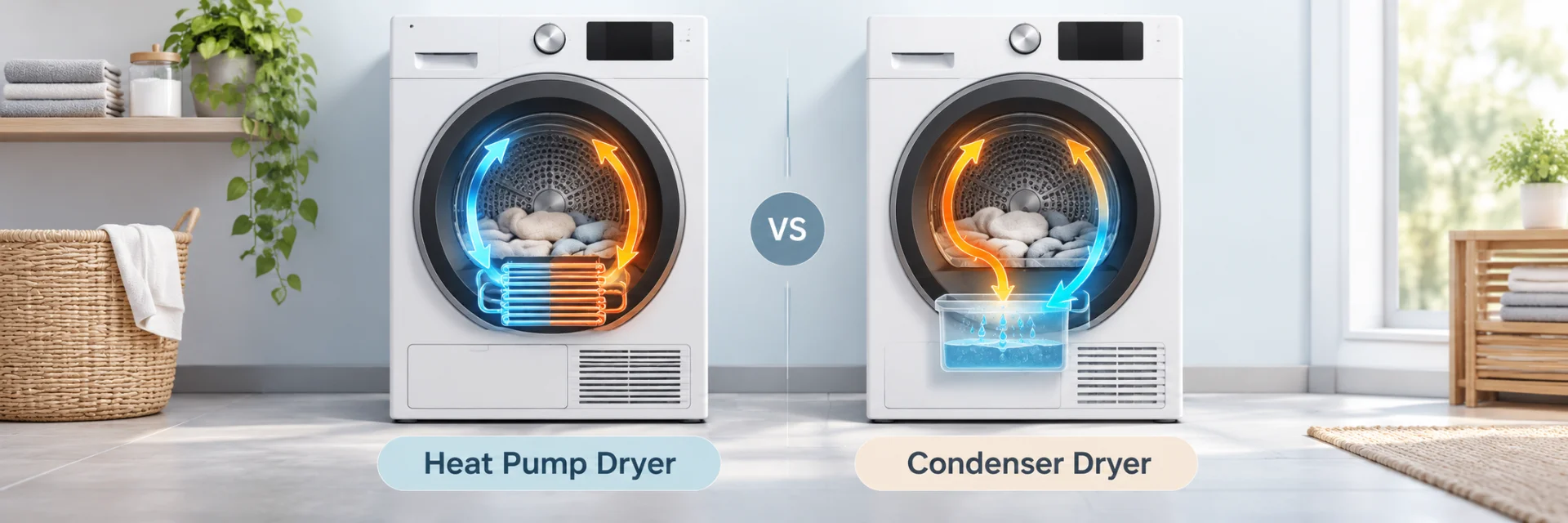
Choosing between a heat pump dryer and a conventional condenser dryer involves more than comparing purchase prices. Both can dry clothes without an external exhaust vent, but they differ in electricity consumption, drying temperature, heat released into the laundry and long-term operating costs.
For Queensland households, the right choice often depends on how frequently the dryer runs and where it will be installed. A family drying several loads each week may benefit from heat pump technology, while someone using a dryer occasionally might prefer the lower upfront cost of a conventional condenser model.
This heat pump dryer vs condenser dryer comparison explains the practical differences so you can decide which appliance makes sense for your laundry, budget and everyday routine.
| Consideration | Heat Pump Dryer | Conventional Condenser Dryer |
| Drying system | Recycles heat using a heat pump | Typically uses electric resistance heating |
| Energy efficiency | Generally higher | Generally lower |
| Drying temperature | Usually lower | Typically higher |
| Cycle duration | Can take longer | May be quicker |
| Heat released into laundry | Generally less | Often more |
| External exhaust vent | Usually not required | Usually not required |
| Water disposal | Tank or drain, depending on model | Tank or drain, depending on model |
| Purchase price | Usually higher | Often lower |
| Running costs | Generally lower | Generally higher |
| Best suited to | Frequent drying and long-term efficiency | Occasional drying and tighter budgets |
These are general differences. Actual performance depends on the appliance, capacity, selected program and installation conditions.
An important distinction is that a heat pump dryer is technically a type of condenser dryer. Both extract moisture from clothing and convert it into liquid water. The main difference is how they heat and reuse the drying air.
Conventional Condenser Dryers
A conventional condenser dryer typically uses an electric heating element to warm air, which passes through wet clothing and absorbs moisture. The moisture is then condensed into water, while heat is discharged from the appliance during operation.
Because the system must continually supply heat, electricity consumption is generally higher.
Heat Pump Dryers
A heat pump dryer uses a refrigeration-based system to remove moisture and recover heat from the circulating air.
Instead of repeatedly generating high-temperature air, it reuses much of the heat within the drying process. This helps reduce electricity consumption and generally allows drying at lower temperatures.
Both technologies usually collect water in a removable reservoir or use a drainage connection, depending on the model.
Heat pump dryers generally have a significant advantage in energy efficiency.
According to Energy Rating Australia’s clothes dryer guidance, heat pump condenser dryers use substantially less energy than conventional alternatives.
However, the savings depend on the individual model and how often you use it.
When comparing dryers, check the Australian Energy Rating Label for:
One important detail is that the annual energy consumption figure for dryers assumes approximately one full load per week. Households running several loads weekly may use considerably more electricity.
This difference can be particularly relevant in smaller Queensland homes.
Conventional condenser dryers often release more waste heat into the surrounding room. In an enclosed laundry, this may make the space noticeably warmer during operation.
Heat pump dryers recover and reuse more heat internally, generally reducing the amount released into the laundry.
Neither technology is completely heat-free or moisture-free.
In an apartment, internal laundry or utility cupboard, check the manufacturer’s ventilation clearances and operating-temperature requirements before installation.
Heat pump dryers generally operate at lower temperatures, which can be beneficial for clothing that is sensitive to excessive heat.
This may help reduce heat-related wear on certain garments, although correct drying programs and fabric-care instructions remain essential.
The trade-off can be cycle duration.
Some heat pump dryers take longer to finish a load, but modern models with moisture sensors and specialised drying programs vary considerably.
Actual drying time depends on load size, fabric thickness, initial moisture content and selected settings.
If drying speed matters, compare the published program times of individual models rather than assuming every conventional condenser dryer will be faster.
Both dryer types can be suitable for apartments because they generally do not require an external exhaust duct.
However, that does not mean either can be installed in an unventilated cupboard.
A heat pump dryer may be preferable where excess room heat is a concern, but the appliance still needs suitable airflow and installation clearance.
Before purchasing, check the dryer’s dimensions, door opening, electrical requirements, drainage options and noise specifications.
If stacking above a washing machine, confirm compatibility with the manufacturer’s approved stacking system.
For other compact laundry configurations, read our washer dryer combo vs separate machines comparison.
Queensland’s climate alone does not determine which dryer is best.
A well-ventilated garage laundry in Brisbane may have different requirements from a compact internal laundry in a Gold Coast apartment.
The more important considerations are room size, ventilation, ambient operating conditions and how often the dryer runs.
Heat pump dryers can offer advantages where reducing waste heat is desirable, but individual models have specified operating-temperature ranges.
Always follow the manufacturer’s installation guidance rather than assuming a particular dryer technology performs equally well in every environment.
Energy efficiency is only one factor to consider when purchasing a dryer. Appliance condition, warranty coverage, correct sizing and installation requirements can also influence the overall cost of ownership. Our guide to dryer buying mistakes that cost more over time explains what to check before purchasing a discounted appliance.
Neither dryer type is maintenance-free.
Both commonly require lint-filter cleaning and water-tank emptying unless connected to drainage.
Conventional condenser dryers may also require regular condenser cleaning. Heat pump models have heat exchangers and additional components that must be maintained according to the manufacturer’s instructions.
Some heat pump dryers include automatic condenser-cleaning features, but requirements vary by model.
A heat pump dryer may be the better investment if you:
A conventional condenser dryer may be more practical if you:
For example, Smart Electronics QLD lists the AEG T858M6OBC 8kg Heat Pump Dryer, featuring SensiDry lower-temperature technology, alongside the Electrolux EDH803R7WC 8kg Heat Pump Dryer. Both provide starting points for comparing available heat pump technology.
Before making your decision, review these practical details:
For frequent dryer users, heat pump technology is often worth considering because of its lower electricity consumption and generally lower drying temperatures.
However, a conventional condenser dryer can still be a sensible purchase when upfront affordability matters more and drying is infrequent.
The best dryer for a Queensland home is the one that suits its laundry space, usage patterns and total ownership budget.
Compare current models in the Smart Electronics QLD dryer range before deciding.
It can be worthwhile for households using their dryer frequently, particularly when energy efficiency and reducing waste heat in a compact laundry are priorities.
Some models have longer drying cycles because they operate at lower temperatures. However, modern heat pump dryers vary considerably, so compare individual program times.
Conventional condenser dryers can release noticeable heat into the surrounding space, especially in enclosed laundries. Adequate ventilation and manufacturer-specified clearances remain important.
They generally do not require an external exhaust duct, but they still need sufficient room ventilation and installation clearance according to the manufacturer’s instructions.
Heat pump dryers generally consume less electricity than comparable conventional condenser models. Check their Australian Energy Rating Labels for a meaningful comparison.

ATOZ 2020 PTY LTD T/A Smart Electrical Clearance Outlet Brisbane
South East Queensland’s Largest Appliance Clearance Outlet for LG, Samsung, Hisense, Westinghouse, Fisher & Paykel, Electrolux, Haier, TCL, Toshiba (TV’s only), AEG and Vintec.
© 2026 SMART ELECTRICAL OUTLET BRISBANE | ATOZ 2020 Pty Ltd
Smart Electrical Brown Plains – Grand Plaza (Near Kmart)
A: Shop G105/27-49 Browns Plains Rd, Browns Plains QLD 4118
P: (07) 3800 1013
E: **@**********om.au
Smart Electrical Mt Ommaney – Mount Ommaney Centre (Inbetween JB HI FI and Best & Less)
A: Shop 56/171 Dandenong Rd, Mount Ommaney QLD 4074
P: (07) 3376 7445
P: 0451 068 031 (Temporary Store Phone)
E: **@**********om.au
Smart Electrical Capalaba – Capalaba Central Shopping Centre (Near Pacific Smiles Dental at the BIG W Entrance)
A: Shop 50-51/38/62 Moreton Bay Rd, Capalaba QLD 4157
P: (07) 3823 4165
E: **@**********om.au
Smart Electrical Strathpine – Strathpine Centre (Near Target)
A: Shop 148/295 Gympie Rd, Strathpine QLD 4500
P: 0451 729 237
E: **@**********om.au
Helensvale Smart Electrical – Westfield Helensvale (In Front of Aldi, near Concierge Desk)
A: 1, Shop 1094/29 Millaroo Dr, Helensvale QLD 4212
P: 0461 322 434
E: **@**********om.au
Mon – Fri: 9:00 AM – 5:00 PM
Thu: 9:00AM – 8:00PM
Sat: 9:00 AM – 4:30PM
Sun: 10:00 AM – 4:00 PM
Opening times may vary store to store, please check with the individual Smart Electrical Clearanace Outlet Stores Locations for exact opening times.


© 2026 Smart Electrical Outlet. | Terms & Conditions | Privacy Policy | All Rights Reserved | Website by SWE
Sign up to the Smart Electrical newsletter and receive a $10 store coupon for your next purchase.

 | Thank you for Signing Up |