



A 90cm oven sounds considerably larger than a 60cm oven. After all, the headline measurement suggests an extra 30cm of width. But does that mean you actually get 50% more room for roasting trays, baking dishes and family meals?
Not necessarily.
When comparing a 60cm vs 90cm oven, external width is only one part of the equation. Internal cavity dimensions, oven height, insulation, shelf design and the way the manufacturer uses the available space all influence how much food you can actually cook at once.
For Australian households choosing between these two sizes, the more useful question is not simply “which oven is bigger?” It is whether the additional usable cooking space of a 90cm model is enough to justify the extra cabinetry and kitchen space it requires.
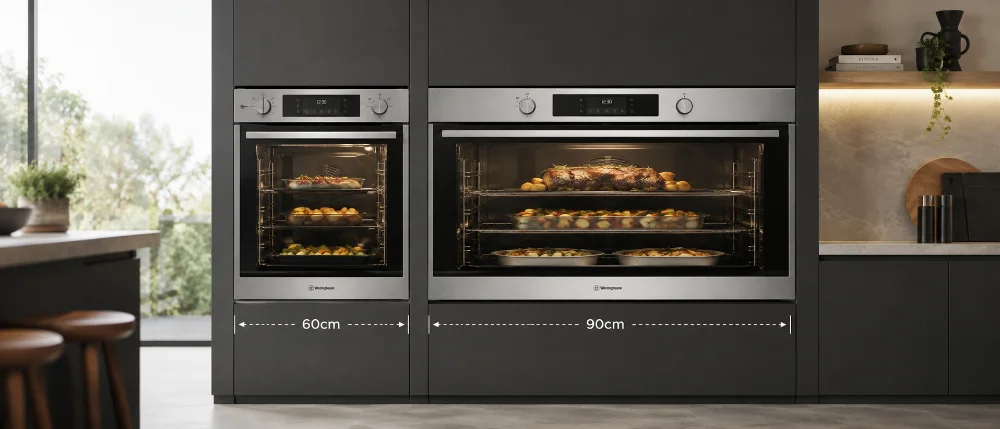
The names primarily describe the approximate external width of the appliance.
A typical product sold as a 60cm built-in oven is designed around the 600mm appliance class, while a 90cm model is substantially wider. Individual dimensions vary, so shoppers should always check the exact product and installation specifications rather than designing cabinetry around the name alone.
For example, Fisher & Paykel lists one current 60cm model at 596mm wide, while its 90cm OB90S9MEB1 measures 895mm wide.
That difference matters significantly when planning cabinetry, but it does not tell you how much cooking space is inside.
Smart Electrical currently stocks ovens across different widths and configurations, so its current oven range is a useful place to compare the actual dimensions rather than relying on the 60cm or 90cm label alone.
No. A 90cm appliance may be roughly 50% wider than a 60cm appliance externally, but you should not expect 50% more internal capacity.
A useful real-world example can be seen within Fisher & Paykel’s range.
Its 60cm OB60SM11PLB1 offers 85L total capacity and 72L usable capacity. The wider 90cm OB90S9MEB1 provides 100L total capacity and 85L usable capacity.
In that particular comparison, the 90cm oven is around 50% wider externally but provides only about 18% more usable stated capacity.
There is another important reason: the two ovens are different shapes. The cited 60cm oven is 598mm high, while the 90cm model is only 478mm high.
That is exactly why an oven capacity comparison should never be based on width alone.
| Consideration | 60cm Oven | 90cm Oven |
| External width | Around the 600mm class | Around the 900mm class |
| Internal capacity | Varies significantly by model | Generally wider, but capacity still varies |
| Wide cookware | Depends on cavity width | Often provides greater side-to-side flexibility |
| Multiple dishes | Can be excellent with good shelf design | Wider cavity may allow more flexible positioning |
| Cabinet requirement | Easier to accommodate in many kitchens | Requires substantially more horizontal space |
| Smaller households | Often more than adequate | Extra space may go unused |
| Large families | Can still work very well | Worth considering for frequent large meals |
| Entertaining | Suitable depending on capacity | Wider cavity can be particularly useful |
Litres are useful, but they do not tell the entire story.
One of the main advantages of a wider oven cavity can be horizontal cooking space.
If you regularly use broad roasting pans, oversized baking dishes or multiple smaller dishes, additional width can sometimes be more useful than simply adding more litres vertically.
Fisher & Paykel, for example, describes its 90cm oven cavity as supporting both side-by-side and multi-shelf cooking. Its 100L model has four shelf positions and an 85L usable capacity.
That can be useful when preparing a large roast alongside vegetables or when several dishes need to be cooked for a gathering.
However, the number of trays you can fit at once still depends on the supplied shelves, tray dimensions, shelf positions and required airflow around the food.
Do not assume that every 90cm oven automatically accepts two standard trays side by side. Check the actual cavity and accessory dimensions for the model you are considering.
This is where looking beyond headline capacity becomes particularly valuable.
A well-designed 60cm oven may provide numerous shelf positions and effective multi-level cooking. Smart Electrical currently lists the Fisher & Paykel 60cm OB60SM11PLB1, for example, with six shelf positions and an 85L total cavity.
The wider 90cm Fisher & Paykel example provides fewer shelf positions but significantly more width.
Neither approach is automatically superior.
If you primarily bake several trays vertically, shelf positions and even multi-level heat circulation may matter more.
If you cook broad trays or want dishes alongside each other, cavity width could be more valuable.
This is why shoppers should think about the cookware they actually own, rather than simply comparing litre figures.
For occasional family roasts, a good 60cm oven may already provide all the capacity you need.
Smart Electrical currently lists several 60cm ovens around the 80–85L total-capacity range, illustrating that a standard-width oven does not necessarily mean a small cavity.
A 90cm oven becomes more compelling when you frequently cook:
large roasting dishes, several side dishes at once, big batches of baked food, meals for extended family, or food for regular entertaining.
The advantage is not necessarily that every meal suddenly requires 100 litres of space. It is having greater flexibility when those larger cooking occasions arise.
For someone who cooks dinner for one or two people most nights and entertains only occasionally, much of that extra width may remain unused.
For many households, yes.
Household size alone should not determine oven size. A family of five that prepares straightforward meals may need less oven space than a couple that regularly hosts ten people.
Cooking style matters more.
A modern 60cm oven with a well-designed cavity can handle substantial meals, and some models sold through Smart Electrical provide 80L or more of total capacity.
A larger oven for a large family becomes more valuable when multiple dishes regularly need oven space simultaneously.
Before becoming attached to a particular oven size, measure the kitchen.
Moving from a 60cm to a 90cm built-in oven is not necessarily a straightforward appliance swap.
The manufacturer’s installation documentation needs to be checked because cabinetry openings can differ substantially. For one Fisher & Paykel example, the 60cm planning guide specifies a minimum internal cavity width of 560mm, while its 90cm model requires 860mm.
Those figures apply to those specific products rather than every oven on the market, but they illustrate the scale of the difference.
A 90cm oven may therefore make good sense during a new kitchen build or substantial renovation but be considerably less practical when simply replacing an existing 60cm built-in appliance.
Always use the installation guide for the exact model being purchased. Fisher & Paykel itself notes that its general planning documents are not substitutes for product-specific installation instructions.
A 60cm model is often the more practical choice when existing cabinetry already accommodates that size, bench and storage space are valuable, or the household rarely needs unusually wide cookware.
It can also make sense when the extra budget required for a wider oven would be better spent on features you use more frequently, such as pyrolytic cleaning, telescopic runners, steam functions or improved cooking controls.
The goal is not to buy the largest oven that fits.
It is to buy enough usable oven space for the way you actually cook.
A 90cm oven becomes easier to justify when cooking space is routinely a constraint.
Regular entertainers, large households and enthusiastic home cooks may particularly appreciate being able to arrange wider cookware or several dishes more comfortably.
During a kitchen renovation, it can also be easier to plan cabinetry around a wider appliance from the beginning rather than trying to retrofit one later.
Before deciding, compare the cavity capacity, usable capacity, internal width, shelf positions and supplied trays of the exact models you are considering.
The manufacturer’s 90cm oven specifications and planning information provide a good example of the detail worth checking before purchase.
Before buying, compare five things: the exact appliance and cavity dimensions, stated usable rather than just total capacity, internal shelf positions, the dimensions of the trays and cookware you regularly use, and whether your existing cabinetry can accommodate the appliance.
If you are purchasing a clearance or factory-second model, also check condition, warranty and installation requirements. Smart Electrical’s existing factory second oven comparison guide covers those considerations separately, keeping this size comparison focused on cooking space.
For ongoing maintenance after purchase, the site’s appliance Guides hub also includes an Oven Care Guide.
The biggest lesson from the 60cm vs 90cm oven comparison is that 30cm of extra external width does not automatically mean a proportional increase in usable cooking capacity.
A wider oven can provide a valuable advantage for large roasting dishes, side-by-side cooking, entertaining and households that frequently prepare several dishes at once. But a well-designed 60cm oven can still offer substantial capacity while fitting far more easily into an existing Australian kitchen.
Rather than choosing based on width alone, compare the usable litres, cavity dimensions, shelf arrangement and your own cookware.
If the 90cm model gives you space you will genuinely use, the extra cabinetry width may be worthwhile. If your cooking already fits comfortably into a good 60cm oven, going wider simply because it sounds bigger may offer less practical benefit than expected.
It is substantially wider externally, but the increase in internal cooking capacity is not necessarily proportional. Internal height, insulation, cavity design and shelf layout all affect usable space.
Often, but not universally. Some 90cm ovens provide wider cavities and greater total capacity, but shoppers should compare the litres and internal measurements of individual models rather than relying on width alone.
Usually not without checking or modifying the cabinetry. A 90cm built-in model requires substantially more horizontal installation space, and the exact cut-out requirements vary by appliance.
It can be. Some 60cm ovens provide around 80–85L of total capacity. Whether that is sufficient depends more on how much food you cook simultaneously than household size alone.
It can be worthwhile if you regularly use wide cookware, batch cook, entertain or prepare multiple oven dishes simultaneously. If you rarely run out of space in a 60cm oven, the additional kitchen footprint may provide limited everyday benefit.



© 2026 Smart Electrical Outlet. | Terms & Conditions | Privacy Policy | All Rights Reserved | Website by SWE