


Choosing between a French door vs bottom mount fridge is less about deciding which design is universally better and more about understanding how each one will work in your kitchen.
Both configurations place fresh food above the freezer, which can make everyday refrigerated items easier to access than layouts with the freezer at the top. The bigger differences are usually found in appliance width, door design, freezer organisation, usable storage and how comfortably the fridge fits your household’s routines.
If you are already comparing these two configurations, the following practical differences can help you work out which is the best fridge layout for your home.
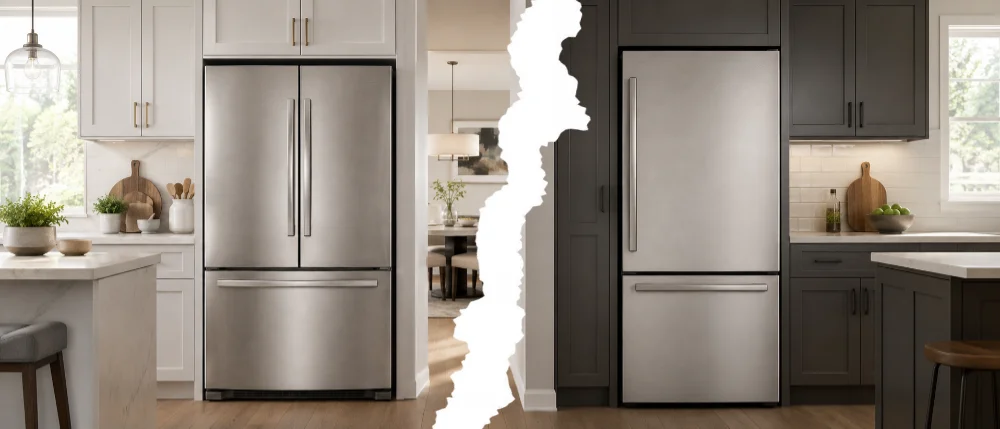
A traditional bottom mount fridge generally has one full-width refrigerator door above a freezer compartment or drawers. It gives you the convenience of keeping frequently used fresh food higher while maintaining a relatively familiar fridge layout.
A French door fridge normally has two side-by-side doors opening into the main refrigerator compartment, with the freezer located below. Depending on the model, the freezer may use one or more drawers or separate compartments.
You can compare the current French door fridge range and bottom mount fridge range at Smart Electrical Outlet to see how much the dimensions, storage arrangements and features can differ between individual models.
| Consideration | French Door Fridge | Bottom Mount Fridge |
| Fresh-food access | High and usually wide | High and straightforward |
| Freezer location | Lower drawers or compartments | Lower drawer or freezer section |
| Overall width | Often wider | Often narrower |
| Door clearance | Two narrower upper doors | One wider main door |
| Large-item storage | Often very flexible | Depends more heavily on shelf width |
| Household suitability | Often suits families and entertainers | Couples, families and space-conscious kitchens |
Because both designs place refrigerated food above the freezer, everyday items such as milk, vegetables, leftovers and drinks can generally be accessed without repeatedly bending towards the bottom of the appliance.
The difference becomes more noticeable when accessing wider items.
French door models can provide a broad refrigerator compartment across the upper section. That can be useful if you regularly store large platters, pizza boxes, meal-prep containers or wide trays.
A bottom mount fridge is usually simpler. Open one door and the entire fresh-food compartment is available. For households that prefer uncomplicated organisation rather than multiple doors and compartments, that simplicity can be an advantage.
Both layouts place frozen food below fresh food, but freezer organisation can feel quite different.
Many bottom mount models use pull-out freezer drawers, baskets or shelves. This can work well when frozen food is grouped into categories and you want a straightforward space for everyday items.
French door fridges may provide multiple drawers or divided freezer compartments. Depending on the model, this can make separating meat, frozen meals, vegetables and bulk purchases easier.
However, more compartments do not automatically mean more usable space. Drawer depth, dividers and internal components can affect what will actually fit.
When comparing models, look beyond the advertised capacity and consider how you personally store frozen food.
Kitchen dimensions are one of the biggest factors in any fridge layout comparison.
French door appliances are commonly associated with larger kitchens because many models offer generous capacity and require a wider fridge cavity. However, there are also slimmer French door models, so the configuration alone does not tell you whether a fridge will fit.
Bottom mount fridges are available across a wide range of sizes and can be easier to accommodate in narrower fridge spaces.
Before buying either style, measure the available width, height and depth as well as nearby cabinetry, walls and benchtops. You also need enough room for doors and drawers to open properly.
The Australian Government recommends starting with the space and capacity you actually need when choosing a fridge and allowing suitable ventilation around the appliance. Exact installation clearances should always be confirmed against the specifications for the individual model.
French door fridges often appeal to people who regularly buy larger quantities of fresh food or entertain at home.
The wide upper refrigerator compartment can make it easier to rearrange shelves around unusual items. Multiple door bins, drawers and adjustable shelves may also provide more ways to organise groceries, although features vary considerably between models.
A bottom mount fridge can still offer excellent storage flexibility without needing as much kitchen width. For couples or smaller households that mainly store standard grocery items, the extra width and compartmentalisation of a French door design may not provide much practical benefit.
The better question is therefore not simply “which fridge has more litres?” but “which layout makes those litres easier for my household to use?”
For a busy fridge for a family kitchen, a French door design can be particularly useful when several people regularly access the refrigerator.
The wide fresh-food section can accommodate weekly grocery shops, larger containers and entertaining food, while divided storage can help keep different types of food organised.
Larger families that buy groceries in bulk may also appreciate the freezer organisation available on some French door models.
That does not rule out bottom mount fridges for families. A generously sized bottom mount model can provide plenty of practical storage while occupying less width, making it a strong option where kitchen space is limited.
For couples and smaller households, a bottom mount fridge may provide all the convenience required without paying for or cooling unused capacity.
A bottom mount fridge will often be the easier starting point for kitchens with limited fridge-cavity width.
However, door clearance also matters.
A single bottom mount refrigerator door needs enough space to swing outward. French door models divide the refrigerator opening between two narrower doors, which can sometimes be helpful when an island, wall or walkway is positioned opposite the fridge.
This is why checking only the external width is not enough. Consider how people move through the kitchen while the fridge is open.
| Layout | Potential Advantages | Potential Disadvantages |
|---|---|---|
| French door | Wide fresh-food storage, flexible organisation, useful for entertaining and larger grocery loads, narrower individual upper doors | Often requires more overall width, additional compartments may reduce usable space, larger capacity may be unnecessary for smaller households |
| Bottom mount | Fresh food at convenient height, simple layout, many narrower options, practical for couples and families | Single fridge door may need greater swing clearance, less width for oversized items, freezer organisation varies by model |
Before deciding between the two configurations, work through five practical questions:
You can browse the full fridge and freezer range to compare available configurations, capacities and current models.
If you are considering a discounted or factory-second model, it is also worth reading the guide on how to inspect a factory second fridge before buying.
There is no single winner in the French door vs bottom mount fridge comparison.
A French door fridge can make sense for larger households, frequent entertainers and shoppers who value wide fresh-food storage and flexible organisation.
A bottom mount fridge can be a better fit when kitchen width is more limited, your household does not need exceptionally large capacity or you simply prefer a straightforward refrigerator layout.
Start with your kitchen dimensions and the way your household actually stores food. Once you know the configuration that suits those requirements, compare individual models for capacity, internal layout, energy efficiency, features and price.
For larger appliances, it is also sensible to confirm access and delivery arrangements before purchasing. Smart Electrical Outlet provides further information in its shipping and appliance delivery policy.
Not automatically. French door fridges can provide wider and more flexible fresh-food storage, while bottom mount fridges can offer similar everyday accessibility in a narrower, simpler format. Your available kitchen space and storage habits matter more than the configuration name.
Some are, particularly slimmer models, but dimensions need to be checked carefully. Consider appliance width, depth, ventilation requirements and whether both doors can open sufficiently around surrounding cabinetry.
Potential drawbacks include greater overall width, more complicated internal layouts and paying for capacity that a smaller household may not use. Individual models vary considerably, so compare actual dimensions and storage arrangements.
Yes. A sufficiently sized bottom mount fridge can work very well for families, particularly where kitchen width is limited. Families that frequently store oversized platters or very large grocery loads may find the wider refrigerator section of some French door models more convenient.
Neither configuration always wins. Advertised capacity does not show how well shelves, drawers, door bins and freezer compartments will suit your groceries. Comparing the internal layout in addition to total litres gives a more realistic picture of usable storage.



© 2026 Smart Electrical Outlet. | Terms & Conditions | Privacy Policy | All Rights Reserved | Website by SWE